
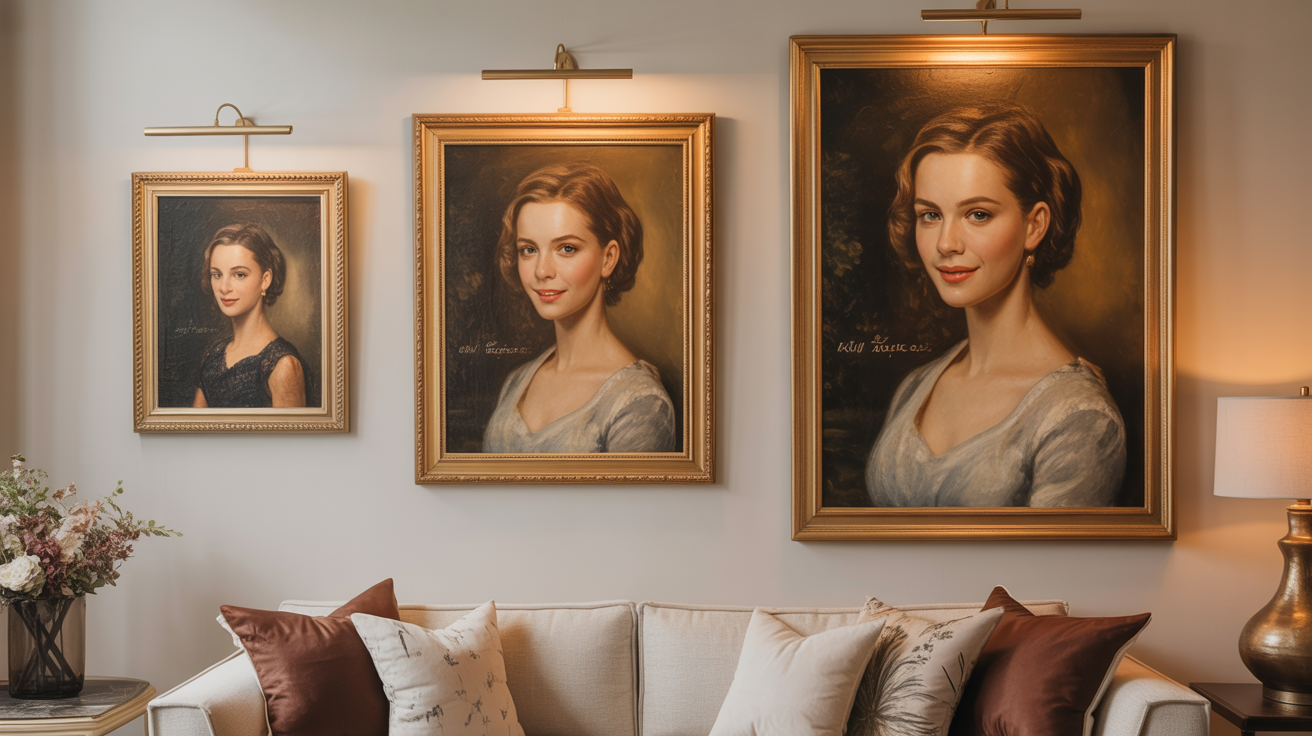
How to Choose the Right Canvas Size for Your Custom Portrait Painting
Not sure which canvas size to order? This complete guide explains how to choose the perfect dimensions for your custom portrait painting based on your wall space, subject, budget, and the visual impact you want to create.
Why Canvas Size Matters More Than You Think
When you commission a custom portrait painting, the canvas size is not just a technical detail — it is a design decision that affects everything: how the painting looks on your wall, how much detail the artist can capture, and how the finished piece makes you feel when you walk into the room.
Choose too small, and a beautiful painting gets lost on a large wall. Choose too large, and it overwhelms the space. Choose just right, and the painting becomes the anchor of the room — the thing that draws every visitor's eye and starts every conversation.
This guide walks you through exactly how to choose the right canvas size for your portrait, whether it is a single subject, a family group, a pet, or a couple.
The Four Standard Canvas Sizes
At PaintedForU, we offer four standard canvas sizes, each designed for a specific purpose and wall placement:
Small: 8×10 Inches
Best for: Desk displays, bookshelves, bedside tables, small gallery walls, gifts with a modest budget.
The small canvas is intimate and personal. It works beautifully for a single headshot — a child, a pet, a loved one — displayed on a desk or as part of a grouped gallery wall. It is also the most affordable option, making it perfect for teacher gifts, stocking stuffers, or first-time portrait buyers who want to experience the quality before committing to a larger piece.
Detail level: The artist captures the essential features — expression, colouring, key characteristics — with slightly less room for background detail.
Price: Starting from $149.
Medium: 12×16 Inches
Best for: Office walls, studies, bedrooms, hallway galleries, single-subject portraits.
The medium canvas is the most versatile size. It is large enough to hang as a standalone piece on a medium-sized wall, yet compact enough to fit into a gallery arrangement with other art. For single-subject portraits — one person, one pet — this size provides excellent detail without dominating the room.
Detail level: Strong facial detail, good background rendering, visible brushwork texture.
Price: Starting from $199.
Large: 16×20 Inches
Best for: Living rooms, dining rooms, above-sofa placement, couple portraits, 2–3 subject compositions.
This is our most popular size, and for good reason. A 16×20 inch portrait commands attention without overwhelming a space. It is the ideal size for a painting that serves as the focal point of a room — above a sofa, a fireplace mantel, or a console table.
For couple portraits and small family groups, this size gives the artist enough space to render each subject with clarity and personality.
Detail level: Excellent detail, rich texture, nuanced colour transitions, substantial background work.
Price: Starting from $249.
Extra Large: 24×36 Inches
Best for: Large living rooms, feature walls, above-fireplace placement, family groups (4+ subjects), statement pieces.
The extra-large canvas is a statement. It transforms a wall into a gallery and a portrait into an experience. At this size, the painting has presence — you feel it when you walk into the room. Individual brushstrokes are visible up close, and the portrait reveals new details with every viewing.
For family groups, team portraits, and compositions with 4 or more subjects, the extra-large canvas ensures every person is rendered with enough detail to be immediately recognisable.
Detail level: Museum-quality detail, visible brushwork, extraordinary colour depth, full background composition.
Price: Starting from $299.
How to Decide: The Three-Factor Method
Choosing the right canvas size comes down to three factors: your wall, your subject, and your impact goal.
Factor 1: Your Wall Space
The painting needs to be proportional to the wall it will hang on. A piece that is too small looks lost; too large looks cramped.
The 60–75% Rule:
The painting should cover approximately 60–75% of the available wall width above your furniture. If you are hanging above a sofa that is 72 inches wide, the ideal painting width is 43–54 inches (or a grouping of smaller pieces that fills that span).
For a standalone portrait above a console table that is 36 inches wide, a 16×20 or 24×36 inch canvas fits beautifully.
The Tape Test:
Before ordering, cut newspaper or cardboard to the exact dimensions of the canvas sizes you are considering. Tape them to the wall where you plan to hang the painting. Step back to the far side of the room and evaluate. This five-minute exercise eliminates sizing regret entirely.
Factor 2: Your Subject
The number of subjects and the type of composition influence the minimum canvas size needed for the artist to capture adequate detail.
| Number of Subjects | Minimum Recommended Size | Ideal Size |
| 1 (headshot) | 8×10 in | 12×16 in |
| 1 (half-body or with pet) | 12×16 in | 16×20 in |
| 2 (couple) | 12×16 in | 16×20 in |
| 3–4 (small family) | 16×20 in | 24×36 in |
| 5+ (large group) | 24×36 in | Custom larger |
Factor 3: Your Impact Goal
What role do you want the painting to play in the room?
- Subtle accent: A smaller canvas (8×10 or 12×16) blends into a gallery wall or sits quietly on a shelf. The painting adds warmth without commanding attention.
- Focal point: A medium-to-large canvas (16×20) draws the eye and anchors the wall. It is the first thing visitors notice when they enter the room.
- Statement piece: An extra-large canvas (24×36 or custom) dominates the wall and defines the room's character. It is not just a painting — it is an experience.
Size Recommendations by Room
Living Room
The living room is where most portrait paintings live. Above the sofa is the most common placement.
- Above a standard 3-seater sofa: 16×20 or 24×36 in
- Above a love seat: 12×16 or 16×20 in
- On a feature wall (no furniture below): 24×36 in or larger
- As part of a gallery wall: Multiple 8×10 or 12×16 pieces
Bedroom
Bedroom portraits tend to be more personal and intimate — a spouse, a child, a pet.
- Above the headboard: 16×20 or 24×36 in
- On a nightstand: 8×10 in
- On a dresser or vanity wall: 12×16 in
Hallway or Staircase
Hallways are perfect for portrait galleries — a series of smaller portraits that tell a family story.
- Single portrait in a narrow hallway: 8×10 or 12×16 in
- Gallery arrangement: Multiple 8×10 in pieces
- Staircase wall: Ascending arrangement of 8×10 or 12×16 in pieces
Home Office or Study
A portrait in a home office adds personality and warmth to a functional space. It also serves as a beautiful backdrop for video calls.
- Behind a desk: 12×16 or 16×20 in
- On a side wall: 8×10 or 12×16 in
Dining Room
Dining room portraits create a sense of occasion and tradition. Family portraits are particularly fitting here.
- Above a sideboard or buffet: 16×20 or 24×36 in
- On a feature wall: 24×36 in
Common Sizing Mistakes to Avoid
Going Too Small "Just to Be Safe"
This is the most common mistake. People err on the side of caution and order a size smaller than they need. The painting arrives, looks beautiful up close, but disappears on the wall it was intended for. If you are between two sizes, go larger — you will almost never regret it.
Ignoring the Frame
A frame adds 2–4 inches to each dimension. If you plan to frame your painting (which we recommend for a finished, gallery look), factor the frame dimensions into your wall calculations. A 16×20 painting in a 3-inch frame becomes a 22×26 inch piece.
Matching Existing Art Exactly
If you are adding a portrait to a wall with existing artwork, it does not need to be the same size. In fact, mixed sizes create a more dynamic and interesting gallery wall. What matters is visual balance — the portrait should feel like it belongs, not that it was measured to match.
Forgetting Viewing Distance
A portrait in a long living room is viewed from 8–12 feet away. A portrait on a desk is viewed from 2 feet. The same painting at the same size will feel completely different in these contexts. Consider where the primary viewing position is and size accordingly.
A Quick Decision Checklist
Answer these questions and you will know your size:
- Where will it hang? Measure the available wall space.
- How many subjects? More subjects need a bigger canvas.
- What role should it play? Accent, focal point, or statement piece.
- Will you frame it? Add frame dimensions to your planning.
- What is your budget? If budget is tight, a beautifully painted small canvas is always better than an unpainted large one.
Still Not Sure?
Send us a photo of your wall space and tell us what subjects you want in the painting. Our art team will recommend the ideal canvas size for your specific situation — free of charge, no obligation.
Every PaintedForU portrait comes with unlimited free revisions, free worldwide shipping, and a 100% satisfaction guarantee.
Start your portrait now and choose the size that transforms your space.Frequently Asked Questions
What is the most popular canvas size for a portrait painting?
The 16×20 inch canvas is our most popular size. It is large enough to make a visual statement on any wall, detailed enough for the artist to capture subtle expressions, and fits standard frames easily. It works beautifully as a focal point in living rooms, hallways, and bedrooms.
What canvas size should I choose for a pet portrait?
For a single pet, 12×16 inches is ideal — large enough to show coat texture and eye detail without overwhelming a space. For multiple pets or a pet with its owner, 16×20 or 24×36 inches gives the artist room to capture each subject clearly.
How do I know what size painting will fit my wall?
A good rule of thumb is that the painting should cover 60–75% of the available wall width above furniture. Measure the wall space, then cut newspaper or cardboard to the canvas dimensions and tape it to the wall. Step back and evaluate before ordering.
Is a bigger canvas always better for a portrait?
Not necessarily. A single headshot on a massive canvas can look oddly magnified, while a detailed group portrait on a tiny canvas loses its impact. The best size depends on the number of subjects, the composition, and where you plan to hang it. Our guide helps you match all three factors.
Can I order a custom canvas size that is not listed?
Yes — contact our art team with your preferred dimensions and we will provide a quote. Custom sizes are common for unusual wall spaces, above-fireplace installations, or when matching existing frames.
What canvas size is best for a group or family portrait?
For 3–5 subjects, a 16×20 inch canvas works well. For larger groups (6+ subjects), a 24×36 inch or custom larger canvas ensures each person is rendered with enough detail to be clearly recognisable. The more subjects, the larger the canvas needs to be.
Marcus Rivera
Lead Portrait Artist
Marcus is PaintForU's lead portrait artist and studio director. With a Fine Arts degree from the Royal Academy, he brings deep knowledge of oil painting techniques to every guide he writes.
Ready to Create Your Portrait?
Free worldwide shipping, unlimited revisions, and 100% satisfaction guaranteed.
Start Your Portrait

