
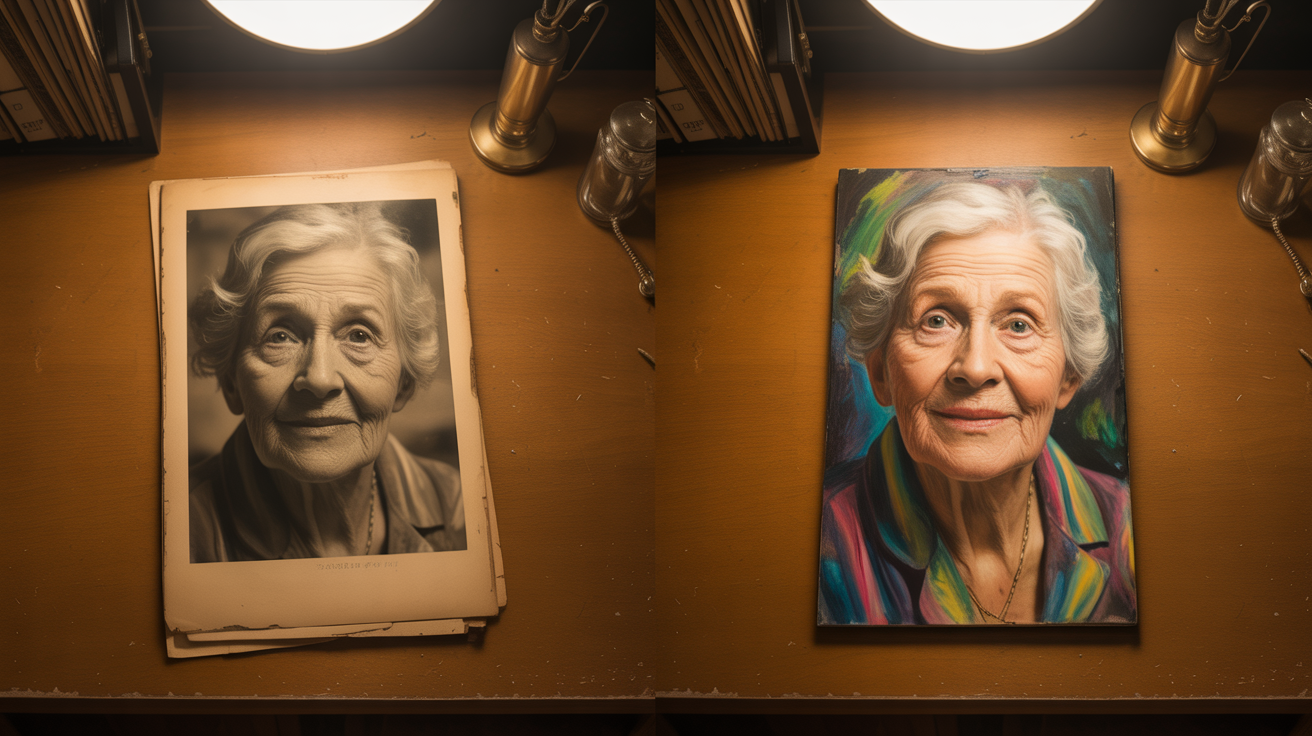
How to Commission a Portrait Painting From an Old or Damaged Photo
That faded, creased, or water-damaged photo does not have to stay broken. Learn how portrait artists can transform old, damaged, or low-quality photographs into stunning hand-painted portraits that bring lost memories back to life.
How to Commission a Portrait Painting From an Old or Damaged Photo
Somewhere in a shoebox, a drawer, or an ageing photo album, there is a photograph you wish you could rescue.
Maybe it is the only picture of your grandmother as a young woman — faded to near-invisibility after decades in a humid attic. Maybe it is a wedding photo from the 1960s with a deep crease running through both faces. Or perhaps it is a childhood snapshot of a parent who passed away, water-stained from a basement flood and too fragile to even touch.
These photographs hold irreplaceable memories. And while the paper they are printed on may be deteriorating, the moments they capture do not have to be lost.
A custom portrait painting can take that damaged, faded, or imperfect photo and transform it into a vibrant, archival-quality work of art that will last for generations. This guide explains exactly how the process works and how to get the best results.
Why Old Photos Make Powerful Portraits
The Emotional Weight Is Already There
Old photographs carry a gravity that recent snapshots rarely match. The subjects are often captured in a specific era — a style of dress, a hairstyle, a setting — that can never be replicated. Converting that moment into a hand-painted portrait amplifies the emotional resonance exponentially.
Paintings Outlast Photographs
A photograph printed on paper has a limited lifespan. Even professionally developed prints degrade over time: colours fade, paper yellows, moisture warps the surface. A hand-painted portrait on stretched canvas, by contrast, is built to last 75–100+ years with minimal care. Commissioning a painting from an old photo is, in a very real sense, future-proofing the memory.
They Honour People Who Deserve to Be Remembered
Many old photos depict people whose only surviving image is the one in your hand. A grandparent, a great-aunt, a family friend from decades past. Turning that photo into a painting gives them a presence in your home that a tucked-away snapshot never could.
Common Types of Photo Damage (and How Artists Handle Them)
Portrait artists are not just painters — they are visual problem-solvers. Here is how they handle the most common forms of photo damage.
Fading and Discolouration
The problem: Colours have washed out, shifted to yellow or magenta, or lost all contrast.
The solution: The artist ignores the colour information entirely and focuses on the tonal structure — the relative lights and darks that define the face, clothing, and background. Colour is then rebuilt from scratch using the artist's understanding of skin tones, hair colour, and period-appropriate clothing hues.
Creases and Fold Lines
The problem: The photo has been folded, bent, or stored improperly, leaving visible lines across the image.
The solution: The artist mentally "erases" the crease by extending the visual information from either side of the line. If a crease runs across a cheek, for example, the artist studies the skin tone and shadow pattern above and below the crease and paints the area as if the crease never existed.
Water Damage and Staining
The problem: Water has caused blotches, mould spots, or areas where the emulsion has lifted away from the paper.
The solution: Similar to creases, the artist works around the damaged areas. Water stains rarely destroy the underlying image completely — there is almost always enough structural information (edges, shadows, proportions) for a skilled artist to reconstruct the affected region.
Tears and Missing Sections
The problem: Part of the photograph is physically missing — torn away, eaten by insects, or destroyed by fire.
The solution: This is where additional reference material becomes crucial. If the missing section includes part of a face, the artist needs another photo of the same person to reconstruct the features accurately. If only the background or clothing is missing, the artist can create a complementary setting based on your instructions.
Low Resolution and Blur
The problem: The photo was taken with an old camera, at a distance, or in poor lighting, resulting in a soft, grainy, or pixelated image.
The solution: Portrait artists are trained to interpret soft images. As long as the basic proportions — the spacing of the eyes, the shape of the jaw, the width of the nose — are discernible, the artist can build a detailed, sharp portrait. Supplementary reference photos help enormously here.
How to Prepare Your Old Photo for a Portrait Commission
The quality of your scan or photograph directly affects the artist's ability to capture accurate details. Here is how to prepare your image.
Scanning Is Best
A flatbed scanner at 600 DPI (dots per inch) is the gold standard. This resolution captures details that are invisible to the naked eye — subtle variations in tone, faint details hidden under stains, and the full tonal range of the original print.
Most public libraries offer free or low-cost scanning services if you do not own a scanner.
Phone Photography Tips
If scanning is not an option, a smartphone camera can work well if you follow these rules:
- Use natural, indirect light. Place the photo near a window on an overcast day. Direct sunlight creates harsh reflections.
- Hold the camera directly above the photo. Angle distortion is the most common mistake. Keep the phone parallel to the photo's surface.
- Do not use flash. Flash creates a bright hotspot that obscures detail.
- Fill the frame. Get as close as possible without cutting off any edges.
- Take multiple shots. Capture at least 3–5 photos and choose the sharpest one.
Send the Original Scan, Not a Filtered Version
Do not apply any filters, auto-enhance features, or adjustments to the scanned image. The artist needs the raw, unmodified scan to make accurate colour and detail decisions.
Adding Colour to Black-and-White Photos
One of the most popular and transformative requests is converting a black-and-white or sepia photograph into a full-colour oil painting.
How the Artist Determines Colour
The artist uses a combination of:
- Your input: If you know the subject's eye colour, hair colour, or the colour of their clothing, include these details in your order notes.
- Historical context: The era of the photograph helps determine likely clothing colours, fabric patterns, and background elements.
- Skin tone analysis: Even in black-and-white photos, tonal values indicate skin undertones. Lighter areas suggest highlights; darker areas indicate shadows and colour depth.
- Reference photos: If you have any colour photos of the same person — even from a different decade — they help the artist establish accurate colouring.
The Result
A colourised oil painting from a black-and-white photo is often the most emotionally impactful portrait type. Seeing a grandparent, who you have only ever known in monochrome, suddenly rendered in vivid, lifelike colour is a genuinely moving experience.
Compositing Multiple Old Photos Into One Portrait
Sometimes the challenge is not damage but incompleteness. You may have:
- A clear photo of your grandfather's face from one image and his full posture from another.
- Separate photos of family members who were never photographed together.
- A photo of a loved one with strangers cropped into the background.
Choosing the Right Style for Old Photo Portraits
Oil Painting
Recommended for: Most old photo restorations.
Oil painting offers the richest colour depth and the most forgiving texture for filling in damaged areas. The layered application of paint naturally smooths over imperfections, and the warm undertones of oil paint are perfectly suited to skin tones and vintage aesthetics.
Watercolour
Recommended for: Lighter, more casual vintage photos.
Watercolour works well when the original photo has a soft, candid quality — children playing outdoors, a relaxed family gathering, or a casual portrait with a natural background.
Pencil Sketch
Recommended for: Photos with very limited detail.
When the original photo is extremely faded or low-resolution, a pencil sketch can be the most effective style. The simplified tonal range of graphite works with limited source information rather than against it, producing a portrait that feels intentionally artistic rather than strained.
The Commission Process: Step by Step
- Upload your photo. Scan or photograph the image and upload it through the PaintedForU ordering system. Include any additional reference photos.
- Add detailed notes. Describe any known colours, any sections you want reconstructed, and any specific instructions for the artist.
- Select your style and size. Choose from oil, watercolour, or pencil sketch, and pick a canvas size that suits the intended display location.
- Review the digital preview. Within 7–10 days, you will receive a digital preview of the painting for approval. Request unlimited revisions until it is perfect.
- Receive your painting. The finished portrait ships free worldwide, ready to hang.
Tips for Getting the Best Result
- Send every photo you have of the subject. Even a blurry group shot from a different angle can help the artist understand facial proportions and body language.
- Describe what you see in the photo. If the image is ambiguous — "That's a floral dress, not a plain one" or "His eyes were blue, not brown" — your notes make all the difference.
- Be specific about the background. If the original background is damaged or unappealing, tell the artist what you would prefer. A simple dark background is classic and elegant; a warm interior setting adds context.
- Mention the relationship. Telling the artist "This is my grandmother at her wedding in 1958" gives them emotional context that subtly influences how they handle the portrait — with extra care, extra attention to period details, and a reverence that shows in the finished work.
The Cost of Photo Restoration Portraits
At PaintedForU, there is no additional fee for working with old or damaged photos. The price is determined solely by canvas size and number of subjects — the same pricing that applies to any custom portrait.
This is a deliberate choice. We believe that preserving memories should not come with a surcharge. Every photo, regardless of condition, deserves the same artistic care.
Visit the pricing page for the complete price breakdown.
Preserve the Memory Before It Is Too Late
Old photographs are finite. Every year that passes, the paper degrades a little more, the colours fade a little further, and the risk of accidental damage grows. A custom portrait painting does not just preserve the image — it elevates it into something permanent, beautiful, and worthy of the person it depicts.
If you have a treasured old photo that deserves better than a deteriorating shoebox, start your portrait today. The memory is waiting.
Frequently Asked Questions
Can a portrait be painted from a blurry or low-resolution photo?
Yes. Experienced portrait artists are trained to interpret soft or pixelated images. As long as the basic facial features and proportions are discernible, the artist can fill in fine details like skin texture, hair strands, and eye colour using their expertise. Providing any supplementary photos of the same person — even from different time periods — helps the artist capture accurate details.
What if part of the photo is torn or missing?
The artist can reconstruct missing areas by studying the remaining portions of the photo and using artistic judgement. If a section of the face is missing, additional reference photos of the same person from a similar era are extremely helpful. For missing backgrounds or clothing, the artist can create a complementary setting based on your instructions.
Can a water-damaged or stained photo still be used?
Absolutely. Water stains, mould spots, and discolouration affect the surface of the photograph but do not destroy the underlying image information. A skilled artist looks past the damage to the composition, facial structure, and pose beneath. Scanning the photo at high resolution before sending often reveals more detail than the naked eye can see.
Should I scan the old photo or take a picture with my phone?
A flatbed scanner at 600 DPI produces the best results because it captures consistent detail across the entire image. If you do not have a scanner, photograph the image in bright, even natural light (not direct sunlight), hold the camera directly above and parallel to the photo to avoid distortion, and avoid using flash as it creates glare that hides details.
Can colour be added to a black-and-white photograph?
Yes. One of the most popular requests is converting a black-and-white or sepia photo into a full-colour oil painting. The artist uses historical context, family descriptions, and reference material to select accurate skin tones, hair colour, eye colour, and clothing hues. If you know specific colours — such as eye colour or the colour of a dress — include those details in your order instructions.
How much does it cost to paint a portrait from a damaged photo?
Portraits from damaged or old photos are priced the same as any custom portrait at PaintedForU — there is no additional restoration fee. The price depends on canvas size and number of subjects. Visit the pricing page for the complete breakdown.
Marcus Rivera
Lead Portrait Artist
Marcus is PaintForU's lead portrait artist and studio director. With a Fine Arts degree from the Royal Academy, he brings deep knowledge of oil painting techniques to every guide he writes.
Ready to Create Your Portrait?
Free worldwide shipping, unlimited revisions, and 100% satisfaction guaranteed.
Start Your Portrait

