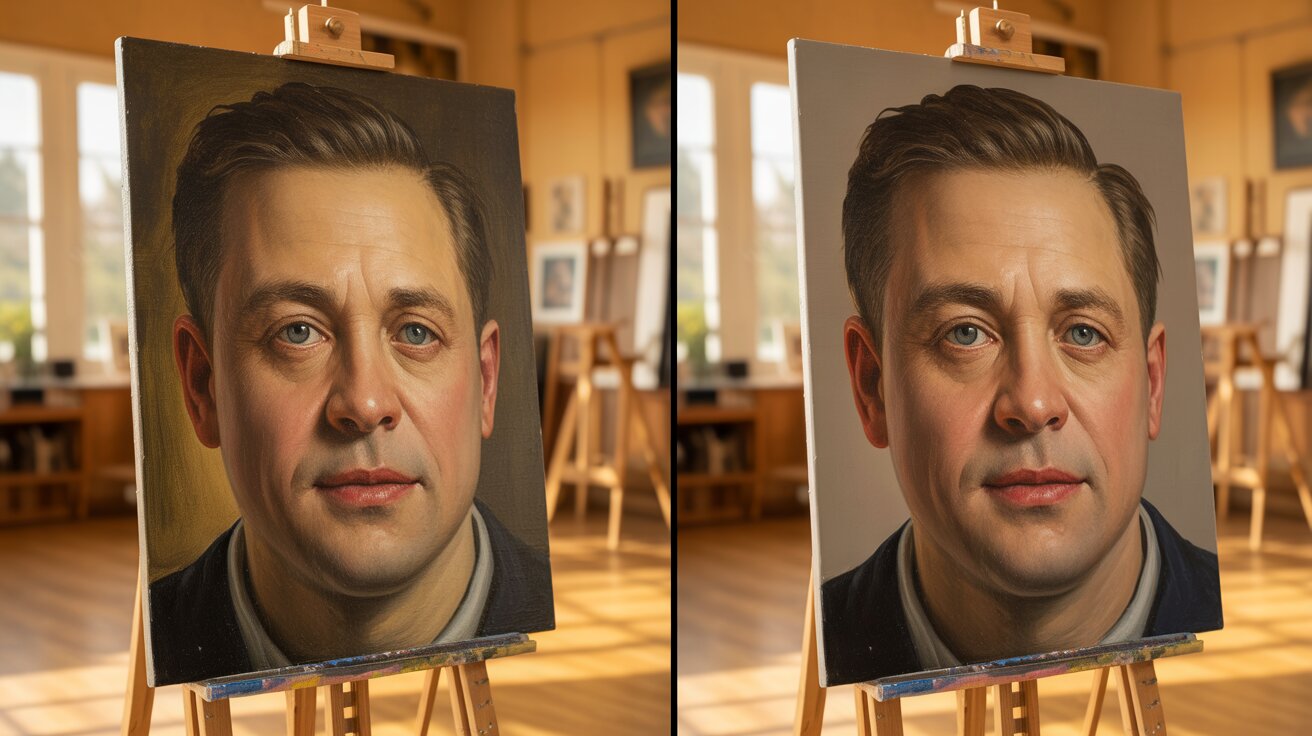
Custom Oil Portraits vs. Digital Prints: What's the Difference?
Thinking about a custom portrait but unsure whether to choose a hand-painted oil painting or a digital print? This side-by-side comparison breaks down the differences in quality, texture, longevity, and emotional value so you can make the right choice.
Why This Comparison Matters
When you search for a custom portrait online, you will find two very different products marketed under the same banner. Some companies deliver genuine hand-painted oil portraits created by professional artists. Others deliver digital prints — images produced by a printer on paper or synthetic canvas, sometimes created using software or AI.
Both are called "custom portraits." Both can feature your photo. But they are fundamentally different products with different qualities, different lifespans, and very different emotional impact. Understanding these differences before you order saves you from disappointment and helps you get exactly what you are paying for.
What Is a Hand-Painted Oil Portrait?
A hand-painted oil portrait is an original work of art. A trained artist mixes pigments with linseed oil, applies them to primed canvas with brushes and palette knives, and builds the image layer by layer over days or weeks. Every stroke is a deliberate decision — the thickness of paint, the direction of the brush, the blending of colour transitions.
Key characteristics:
- Created by a human artist using real oil paint on real canvas
- Each piece is completely unique — no two are identical
- Physical texture you can see from across the room and feel with your fingertips
- Rich, luminous colour with depth that changes subtly in different lighting
- Built in layers over 1 to 3 weeks of drying and painting time
- Typically finished with protective varnish for longevity
What Is a Digital Print?
A digital print is a reproduction produced by a high-resolution printer. The source image may be a digitally enhanced photograph, a digital painting created in software like Photoshop or Procreate, or increasingly, an AI-generated image. The finished file is then printed onto paper, canvas-textured media, or synthetic canvas using inkjet technology.
Key characteristics:
- Produced by a printer, not by an artist with a brush
- Identical copies can be printed indefinitely
- Completely flat surface with no physical texture
- Colours are determined by ink chemistry and printing calibration
- Produced in minutes once the digital file exists
- May fade over time depending on ink quality and UV exposure
Side-by-Side Comparison
Texture and Surface
This is the most immediately visible difference and the one that matters most to most people.
Oil portrait: The surface is alive with texture. Brushstrokes create ridges and valleys in the paint. Thick applications (impasto) in highlights catch light and create shadows. Subtle blending in skin tones produces smooth transitions. You can run your fingers across the surface and feel every mark the artist made. From across the room, this texture gives the painting a three-dimensional presence that draws you in.
Digital print: The surface is uniformly flat. Whether printed on paper or canvas, there is no variation in surface height. Some printers apply a texture coating to simulate brushstrokes, but the result is a repeating mechanical pattern that looks and feels artificial — especially next to a genuine painting.
Verdict: Oil portrait wins decisively. Real texture cannot be replicated by a printer.
Colour Depth and Luminosity
Oil portrait: Oil paints produce colour through pigment particles suspended in drying oil. Light passes through the transparent and semi-transparent layers, bouncing off the white canvas beneath and creating a luminous glow from within. This optical property — called "depth of colour" — is why oil paintings seem to glow in warm light. Colour mixing happens physically on the canvas, producing nuanced, complex tones.
Digital print: Ink sits on the surface of the paper or canvas. Colours are produced by layering cyan, magenta, yellow, and black (CMYK) dots. While modern printers achieve impressive colour accuracy, the result lacks the optical depth of real paint. Printed colours can look flat and slightly muted compared to their oil-painted equivalents, especially in skin tones and shadow areas.
Verdict: Oil portrait. The luminosity of real oil paint is a physical property that printing cannot reproduce.
Longevity and Durability
Oil portrait: A properly varnished oil painting on quality canvas can last 300 to 500 years or more. The world's greatest museums are filled with oil portraits from the 15th and 16th centuries that still look stunning. Professional-grade oil paints are formulated for permanence. The protective varnish can be cleaned and reapplied by a conservator if needed decades later.
Digital print: The lifespan of a digital print depends heavily on ink quality and environmental conditions. Archival pigment inks on acid-free paper can last 75 to 100 years under ideal conditions (no direct sunlight, controlled humidity). Standard dye-based inks on regular media may begin fading noticeably within 10 to 20 years, especially near windows. Canvas prints are particularly vulnerable to cracking and peeling over time.
Verdict: Oil portrait, by centuries. If you want something that lasts for generations, there is no competition.
Uniqueness
Oil portrait: Every hand-painted portrait is a one-of-a-kind original. Even if the same artist painted the same photo twice, the two paintings would be visibly different — different brushwork, different colour mixing decisions, different interpretations of light and shadow. Your portrait is the only one that exists in the world.
Digital print: A digital file can be printed an unlimited number of times. Every copy is identical. Your "custom" print could theoretically be reproduced thousands of times at the click of a button. While the source image may be customised to your photo, the physical product is a copy, not an original.
Verdict: Oil portrait. Originals have a meaning and value that reproductions cannot.
Emotional Impact
Oil portrait: There is a reason oil paintings have been the preferred medium for portraiture for half a millennium. A hand-painted portrait communicates investment, intention, and permanence. It says: someone spent days creating this by hand, specifically for you. When displayed in a home, an oil portrait commands attention and sparks conversation. When given as a gift, it becomes a treasured heirloom.
Digital print: A print is a nice piece of decor. It can be attractive and well-composed. But it carries a different emotional weight. The recipient knows it was produced by a machine in minutes. It does not have the same sense of craftsmanship, uniqueness, or permanence. It is appreciated, but rarely treasured the way a hand-painted portrait is.
Verdict: Oil portrait. Art created by human hands carries meaning that mass production cannot match.
Price
Oil portrait: Genuine hand-painted oil portraits typically range from $149 to $500+ depending on canvas size, number of subjects, and complexity. At PaintForU, prices start at $149 for an 8×10 inch single-subject portrait. The price reflects the skill of the artist, the quality of materials, and the time invested (typically 1 to 3 weeks of work).
Digital print: Digital prints typically cost $30 to $100 depending on size and printing quality. The lower price reflects the lower cost of production — once the digital file exists, printing is fast and inexpensive.
Verdict: Digital prints are less expensive. But the price difference reflects a fundamental difference in what you are buying. A hand-painted portrait is an investment in original art. A digital print is a purchase of a printed copy.
Common Marketing Tactics to Watch For
Some companies blur the line between paintings and prints, whether intentionally or through vague marketing. Here are some phrases that often indicate you are buying a digital print, not a hand-painted portrait:
- "Hand-painted effect" or "painterly style" — this usually means digital filters applied to a photo
- "Printed on premium canvas" — the word "printed" tells you everything
- "Gallery-wrapped canvas print" — a print stretched over a frame, not a painting
- "Digital oil painting" — a contradiction in terms; oil painting requires physical oil paint
- "AI-enhanced portrait" — AI-generated or processed, then printed
- Delivery in 3 to 5 days — genuine oil paintings take 1 to 3 weeks minimum
- Prices under $50 for a "hand-painted" portrait — the materials alone cost more than this
- ✅ Process photos or videos showing an artist painting on canvas
- ✅ Close-up shots with visible brushstroke texture
- ✅ Stated use of oil paints, linen or cotton canvas, and protective varnish
- ✅ Realistic timelines of 2 to 4 weeks
- ✅ A digital preview stage before the painting is finalised
When a Digital Print Makes Sense
Digital prints are not inherently bad — they serve a different purpose. A digital print might be the right choice if:
- You need multiple identical copies (e.g., prints for different family members)
- You are decorating a temporary space like a student flat or office
- Your budget is under $100 and you want a quick piece of wall art
- You want to test how a portrait looks in a space before committing to a painting
When to Choose a Hand-Painted Oil Portrait
An oil portrait is the right choice when the portrait matters. Specifically:
- Gifts for milestone occasions — weddings, anniversaries, retirements, graduations
- Memorial portraits of loved ones who have passed
- Family heirlooms intended to be passed down through generations
- Home centrepieces for living rooms, studies, or formal spaces
- Pet portraits that honour a beloved companion
- Self-portraits or couple portraits that celebrate a relationship
The PaintForU Difference
Every portrait from PaintForU is:
- 100% hand-painted by a trained artist using professional-grade oil paints
- Created on museum-quality cotton canvas stretched over kiln-dried wooden bars
- Finished with a protective satin varnish for decades of lasting colour
- Delivered with free worldwide shipping in professional packaging
- Backed by unlimited free revisions and a 100% satisfaction guarantee
Frequently Asked Questions
Is a hand-painted oil portrait really worth the extra cost over a digital print?
Yes. A hand-painted oil portrait is a one-of-a-kind work of art created by a professional artist using real paint on real canvas. It has physical texture, rich colour depth, and can last centuries with basic care. A digital print is a mass-reproducible copy printed on paper or synthetic canvas with no texture or individuality. The price difference reflects the difference between owning original art and owning a printed copy.
How long does a hand-painted oil portrait last compared to a digital print?
Oil paintings can last 300 to 500 years or more when properly cared for and varnished. Digital prints typically last 20 to 75 years before colours fade significantly, depending on ink quality and UV exposure. Museum-quality oil paints and protective varnish give hand-painted portraits a dramatically longer lifespan.
Can you tell the difference between an oil portrait and a digital print in person?
Absolutely. The difference is immediately obvious when viewed up close. An oil portrait has three-dimensional brushstroke texture you can see and feel, with paint that catches light at different angles. A digital print is completely flat and smooth, with no physical texture. The colour depth, warmth, and presence of a real painting are impossible to replicate with ink on paper.
Are digital portrait prints hand-painted?
No. Digital prints are produced by a printer, not by an artist with a brush. Some services create a digital painting using software or AI, then print the result onto canvas or paper. While the digital artwork may look painterly on screen, the final product has no real paint, no brushstroke texture, and none of the qualities that make a hand-painted portrait special.
Do digital prints on canvas look like real paintings?
From a distance, a high-quality digital print on textured canvas can loosely resemble a painting. However, up close the illusion breaks down completely. There are no raised brushstrokes, no variations in paint thickness, and the surface is uniformly flat. Many canvas prints also have a slightly plastic or glossy appearance that real oil paint does not.
What should I choose for a meaningful gift: oil portrait or digital print?
For a truly meaningful, heirloom-quality gift, a hand-painted oil portrait is the clear choice. It communicates thoughtfulness, investment, and permanence in a way a printed copy cannot. Oil portraits are the traditional medium for commemorating loved ones, and they become more cherished with time. Digital prints work well for casual decor but lack the emotional weight of original art.
Sarah Chen
Senior Art Consultant
Sarah is a Senior Art Consultant at PaintForU with over 12 years of experience in custom portrait commissions. She specialises in helping clients choose the perfect style and composition for their portraits.
Ready to Create Your Portrait?
Free worldwide shipping, unlimited revisions, and 100% satisfaction guaranteed.
Start Your Portrait

