Hand-Painted vs. AI-Generated Art: An Honest Comparison for Gift Buyers
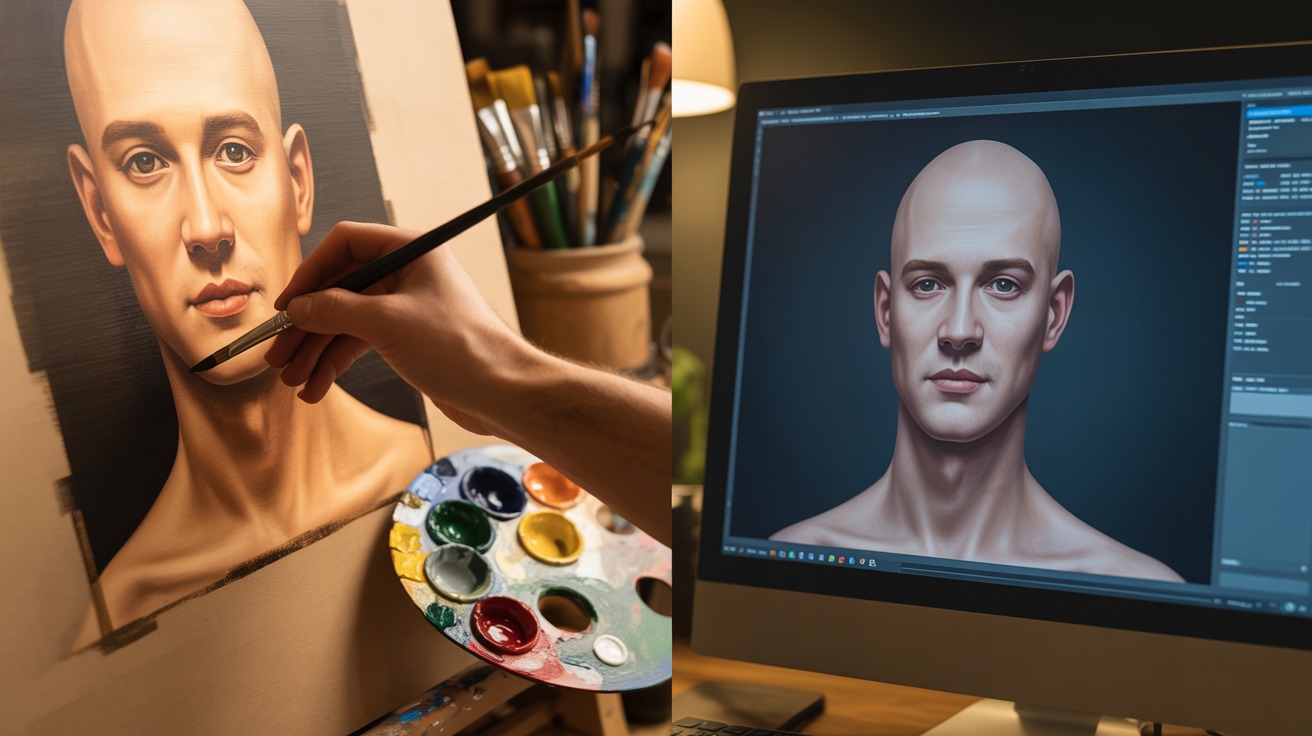
AI can generate a portrait in seconds. A human artist takes days. So why would you choose the slower, more expensive option? Because the difference — in quality, meaning, and emotional impact — is enormous.
The Question Every Gift Buyer Is Asking
You want to give someone a portrait. You have seen the AI art generators — type a prompt, wait 30 seconds, and an image appears. It looks painterly. It looks impressive. And it costs a fraction of what a hand-painted portrait costs.
So why would anyone still choose the slow, expensive, human-made option?
This is an honest comparison. No demonising AI. No pretending hand-painted art is perfect. Just a clear-eyed look at what each option actually delivers — so you can decide which one is right for the gift you are trying to give.
What AI Art Actually Is
AI image generators like Midjourney, DALL-E, and Stable Diffusion are trained on millions of existing images. When you provide a prompt — or a photograph — the algorithm generates a new image based on patterns it has learned. The result can look sophisticated, artistic, and even "painterly."
But it is important to understand what is happening: the AI is not painting. It is not making artistic decisions. It is not studying a face and deciding how to capture the expression. It is performing statistical pattern matching on a massive dataset and producing an output that is probabilistically likely to look good.
The result is an image. It is not a painting.
What a Hand-Painted Portrait Actually Is
A hand-painted oil portrait is created by a human artist who studies your photograph, interprets the subject, and translates that interpretation into paint on canvas over the course of several days. Every brushstroke is a deliberate choice — the colour, the pressure, the direction, the thickness of the paint.
The artist is not copying the photo. They are interpreting it. They decide which details to emphasise, which to soften, how to handle the light, and what the background should convey. The result carries the artist's understanding, empathy, and skill — qualities that no algorithm possesses.
The Comparison
Likeness Accuracy
Hand-painted: A trained portrait artist studies facial proportions with the precision of someone who has painted hundreds of faces. They understand how a millimetre of difference in the placement of an eye changes the entire expression. The result is a portrait that genuinely looks like the person.
AI-generated: AI frequently alters facial features — smoothing imperfections, symmetrising asymmetrical faces, adjusting proportions in subtle ways that make the person look "off." The image may be attractive, but it often does not look exactly like the subject. For memorial portraits or gifts where likeness matters deeply, this is a significant limitation.
Physical Presence
Hand-painted: An oil painting is a physical object with texture, depth, and weight. Brushstrokes rise from the canvas. Paint layers create a luminosity that changes as the light shifts. The painting has a presence on the wall that commands attention.
AI-generated: AI produces a digital file. It can be printed on canvas, paper, or any other surface — but the print is flat, textureless, and identical to every other copy of the same file. It is a picture of a painting, not a painting.
Emotional Impact
Hand-painted: When you give someone a hand-painted portrait, you are giving them the knowledge that a real person spent days studying the face of someone they love and painting it by hand. That knowledge adds emotional weight that no printed image can carry. The gift says: I valued this person enough to commission an artist.
AI-generated: The recipient knows — or will quickly realise — that the image was generated by a machine in seconds. The effort involved is typing a prompt. The emotional message is fundamentally different.
Uniqueness
Hand-painted: One of one. No identical painting exists anywhere in the world. The specific brushstrokes, the exact colour mixing, the artist's interpretation — all unique.
AI-generated: Infinitely reproducible. The same prompt can generate similar images endlessly. There is no original, no scarcity, no uniqueness.
Longevity
Hand-painted: Centuries. Oil on canvas, properly varnished, is one of the most durable art forms ever created. Museum collections prove this daily.
AI-generated: A digital file lasts as long as the storage medium. A canvas print of an AI image lasts 10–25 years before noticeable fading. Neither will become a family heirloom.
Cost
Hand-painted: Starting at $149 at PaintedForU. This reflects days of skilled labour, professional materials, unlimited revisions, and free shipping.
AI-generated: Free to a few dollars. This reflects the cost of computing resources to run an algorithm for 30 seconds.
The price difference is real. Whether it is justified depends on what you value and what the gift is for.
When AI Art Is Reasonable
AI art is not inherently bad. It has legitimate uses:
- Concept exploration — generating quick visual ideas before committing to a final approach
- Social media content — images for posts that have a short lifespan
- Casual decoration — filling a wall in a temporary space
- Fun and experimentation — playing with styles and ideas for personal enjoyment
When Only Human Art Will Do
For anything that carries emotional weight, human-painted art is the right choice:
- Gifts that say something — birthday, anniversary, wedding, retirement
- Memorial portraits — honouring someone who has passed demands the gravity of handcrafted art
- Family heirlooms — something you want to pass to your grandchildren
- Focal point art — the centrepiece of a room that defines the space
- Anything you would frame — if it deserves a frame, it deserves to be real
The Tell-Tale Signs of AI Art
Even the best AI-generated portraits have tells:
- Unnaturally smooth skin — AI tends to over-smooth textures
- Inconsistent details — one ear perfectly rendered, the other slightly malformed
- Hands and fingers — AI notoriously struggles with hands
- Symmetry overload — real faces are asymmetrical; AI tends to normalise them
- No physical texture — even when printed on canvas, the surface is flat
- Uncanny valley — something feels "off" even if you cannot pinpoint what
What the Gift Really Says
Ultimately, the choice between hand-painted and AI-generated art comes down to what you want the gift to communicate.
An AI image says: I thought of you.
A hand-painted portrait says: I valued you enough to commission an artist to study your face and paint it by hand, on canvas, with care.
Both are gestures. Only one is an heirloom.
Every PaintedForU portrait comes with unlimited free revisions, free shipping, and a 100% satisfaction guarantee.
Start your portrait now and give them something a machine cannot make.Frequently Asked Questions
Is AI art good enough for a gift?
For a casual, low-stakes gift, AI art can suffice. For anything meaningful — a memorial, a milestone, a family portrait — AI art lacks the emotional weight, physical presence, and lasting quality that make a gift truly special. The recipient will know the difference.
Can AI replicate the look of an oil painting?
AI can mimic the surface appearance of an oil painting in a digital image, but it cannot replicate the physical texture, visible brushstrokes, colour depth, or luminosity of actual oil pigments on canvas. The difference is immediately apparent in person.
Why is hand-painted art more expensive than AI art?
A hand-painted portrait requires days of skilled labour by a trained artist using professional materials. AI generates images in seconds using software. The price reflects the difference between handcrafted, one-of-a-kind art and mass-produced digital output.
Does AI art have any resale or heirloom value?
No. AI-generated images are infinitely reproducible and have no uniqueness, scarcity, or provenance. They cannot be considered heirlooms. A hand-painted portrait is a one-of-a-kind original that appreciates in sentimental and potentially financial value over time.
Can AI accurately capture a likeness?
AI frequently struggles with accurate likeness — subtly altering facial features, proportions, and expressions. A human artist studies the subject with intent, making deliberate decisions about every feature to ensure the portrait truly looks like the person.
Will the recipient know if art is AI-generated?
Very likely. AI art has tells — unnaturally smooth textures, inconsistent details, slightly off proportions, and no physical texture. Anyone who looks closely will recognise the difference. And the absence of a human artist's involvement changes the emotional meaning of the gift entirely.
Marcus Rivera
Lead Portrait Artist
Marcus is PaintForU's lead portrait artist and studio director. With a Fine Arts degree from the Royal Academy, he brings deep knowledge of oil painting techniques to every guide he writes.
Ready to Create Your Portrait?
Free worldwide shipping, unlimited revisions, and 100% satisfaction guaranteed.
Start Your Portrait

