
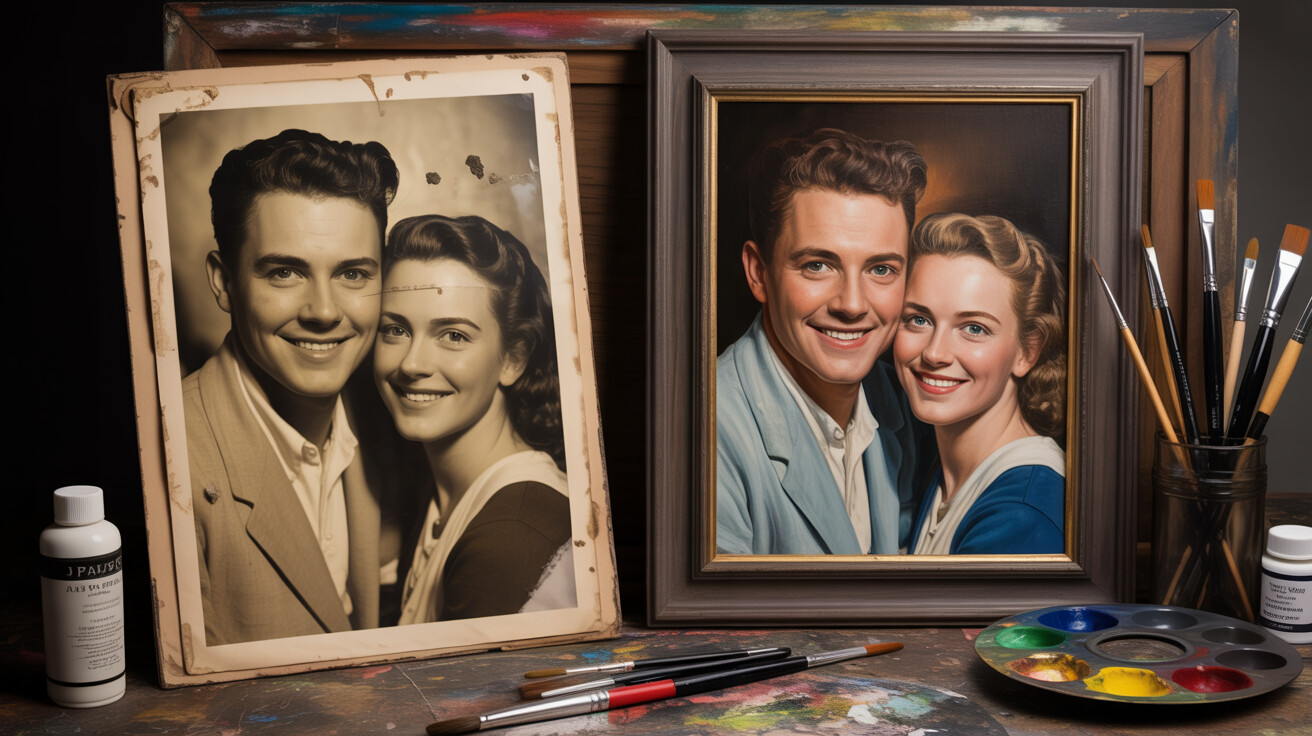
Turning Old or Blurry Photos into Beautiful Portrait Paintings
That faded Polaroid, that grainy phone photo from 2005, that slightly blurry snapshot of your grandmother — they can all become stunning hand-painted portraits. Here is how our artists work with imperfect photos to create perfect paintings.
The Photos That Matter Most
The most important photographs in your life are rarely the best-quality ones.
The only photo of your grandmother as a young woman is a faded black-and-white print with a crease down the middle. The shot of your parents on their wedding day is a slightly overexposed Polaroid. The picture of your childhood dog is a grainy 2-megapixel phone photo from 2005. The family reunion snapshot from 1998 is a 4×6 print that has yellowed with age.
These are the photos that matter. And the fact that they are imperfect — low resolution, faded, blurry, damaged — does not mean they cannot become beautiful paintings.
At PaintedForU, our artists work with imperfect photos every day. It is one of the things that makes hand-painted portraits fundamentally different from prints, enlargements, or digital enhancements. An artist does not reproduce a photo. An artist interprets it.
What Our Artists Can Work With
Faded Photos
Colour photographs from the 1970s, 1980s, and 1990s are often severely faded — the reds have shifted to orange, the blues have washed out, and the contrast has flattened. Our artists mentally "reverse" the fading, painting skin tones, hair colour, and clothing as they would have appeared in life, not as they appear in the degraded print.
Low-Resolution Photos
Early digital cameras and older smartphones produced images that look fine on a small screen but fall apart when enlarged. A 640×480 pixel photo from 2003 does not contain enough detail for a large print — but it contains more than enough information for an artist to interpret. The artist supplies the fine detail — the texture of skin, the individual strands of hair — that the camera could not capture.
Blurry Photos
Slightly blurry photos are workable as long as the basic structure of the face is identifiable — the shape of the jaw, the position of the eyes, the general expression. The artist uses artistic judgement and any additional reference photos to fill in what the blur obscures. For significantly blurry images, we may request a second reference photo of the same person from a different time.
Damaged Photos
Torn, creased, water-stained, or sun-damaged prints are not a problem. The artist paints through the damage, reconstructing the image as it would have appeared before the print deteriorated. This is one of the most common requests for memorial portraits — and one of the most rewarding.
Black-and-White Photos
Black-and-white photographs, whether from the 1920s or the 2020s, can be painted in full colour. The artist uses contextual clues — skin tone, era-appropriate clothing colours, likely hair colour — and any information you provide to create a natural, lifelike colour palette. You can also request the painting in black-and-white or sepia if you prefer.
Small Prints
Wallet-size prints, ID photos, and small snapshots contain limited visual information — but often more than you think. A 2×3 inch print scanned at high resolution can reveal surprising detail. And what the scan does not show, the artist's eye can interpret.
How to Prepare Your Photo
Scanning Printed Photos
If your photo is a physical print:
- Use a flatbed scanner at 300 DPI or higher. This captures the maximum detail.
- Scan in colour even if the photo is black-and-white — colour scanning captures more tonal information.
- Do not crop before sending. Let the artist see the full image, including edges and borders.
- Save as JPEG or PNG at the highest quality setting.
No Scanner? Use Your Phone
If you do not have a scanner:
- Place the photo on a flat, dark surface.
- Position yourself directly above it — hold the phone parallel to the photo.
- Use natural, indirect light — near a window, not in direct sunlight. Avoid flash.
- Avoid shadows from your hand or phone falling on the photo.
- Take multiple shots and choose the clearest one.
Providing Additional References
If the main photo is very old, blurry, or small, additional reference photos of the same person help enormously:
- A clearer photo from a different time period
- Photos showing the person's hair colour, eye colour, and skin tone
- Photos showing their typical expression or smile
The Artist's Advantage
A camera records. An artist interprets.
This is the fundamental advantage of commissioning a painting from an imperfect photo rather than trying to digitally enhance it. Digital enhancement can sharpen edges and adjust colour, but it cannot create information that was never captured. It guesses — and it often guesses wrong, producing uncanny, artificial-looking results.
A skilled portrait artist does something entirely different:
- They understand facial anatomy and use that knowledge to interpret blurry or obscured features
- They know how light falls on skin and can reconstruct natural lighting from limited information
- They understand colour theory and can translate faded tones back to their original vibrancy
- They bring aesthetic judgement — deciding what to emphasise, what to soften, and how to create a portrait that honours the subject
Common Scenarios
Memorial Portraits from Old Family Photos
The most common request for old-photo portraits. A grandparent, a parent, a sibling — someone who passed before smartphone cameras existed. Often the only available photo is decades old, faded, and small. Our artists treat these with particular care, knowing the painting may be the family's most important piece of art.
Combining Generations
A photo of a grandfather from 1965 combined with a photo of a grandchild from 2024. The artist matches the lighting, proportion, and style to create a single, cohesive composition — as though the two were standing together.
Restoring Colour to Black-and-White
A black-and-white wedding photo from the 1950s painted in full, natural colour. The artist uses period-appropriate colours for clothing, natural skin tones, and contextual details to create a painting that feels authentic to the era.
Upgrading Early Digital Photos
That 0.3-megapixel camera phone photo from 2004 that captures the only shot of a beloved pet, a first apartment, or a college roommate. Too blurry and pixelated to print — but more than sufficient for a skilled artist to interpret.
The Process
- Upload your photo — any quality, any format. Do not worry about resolution, fading, or damage.
- Add reference photos if available — additional images of the same subject help the artist.
- Include instructions — tell us about the subject. Their eye colour, hair colour, personality. Context helps the artist paint with accuracy and warmth.
- Review the preview — within 7–10 business days, you will receive a digital preview. Request unlimited revisions until the painting is perfect.
- Receive your painting — shipped free worldwide, carefully packaged, ready to hang.
Every Photo Tells a Story
The quality of a photo does not determine the quality of a painting. Some of our most beautiful portraits have been painted from some of our most challenging reference photos — faded Polaroids, tiny prints, grainy screenshots.
What matters is not the resolution of the image. What matters is the meaning behind it.
Every PaintedForU portrait comes with unlimited free revisions, free worldwide shipping, and a 100% satisfaction guarantee.
Start your portrait now and let us turn your most treasured photo — no matter its condition — into a painting that will last for generations.Frequently Asked Questions
Can you paint a portrait from an old, faded photograph?
Yes. Our artists routinely work with old, faded, and discoloured photographs — including scanned prints, Polaroids, and even newspaper clippings. The artist interprets the photo, enhances lost details, and restores natural colour in the painting.
Can you paint a portrait from a blurry photo?
In most cases, yes. If the basic features — face shape, hair, general expression — are identifiable, our artists can work with the image. For very blurry photos, we may ask for additional reference photos to ensure accuracy.
How do I scan an old printed photo for a portrait?
Use a flatbed scanner at 300 DPI or higher. If you do not have a scanner, take a well-lit photograph of the print using your phone — hold the phone parallel to the photo, avoid glare, and use natural light. Free scanning apps like Google PhotoScan also produce good results.
Can you combine an old photo with a newer photo?
Yes. A common request is combining a vintage photo of a grandparent with a modern photo of a grandchild — placing them together in a single painting. Our artists handle composition adjustments, lighting matching, and style consistency.
What if the old photo is damaged — torn, creased, or stained?
Physical damage to the original photo does not affect the painting. The artist paints from the visual information available, interpreting through any tears, creases, or stains. As long as the face is recognisable, we can create a beautiful portrait.
Do you charge extra for working with low-quality photos?
No. PaintedForU pricing is based on canvas size and number of subjects, not photo quality. Working with challenging photos is part of our artists' expertise, and there is no additional fee.
Sarah Chen
Senior Art Consultant
Sarah is a Senior Art Consultant at PaintForU with over 12 years of experience in custom portrait commissions. She specialises in helping clients choose the perfect style and composition for their portraits.
Ready to Create Your Portrait?
Free worldwide shipping, unlimited revisions, and 100% satisfaction guaranteed.
Start Your Portrait

